Daily Summary of Science & Space · Final editionThursday 19 November 2026 · UTC
Science & Space News: 19 November 2026
China's first foreign astronaut nears launch as Voyager 1 loses data
China rolled out the Shenzhou-24 rocket that will carry its first international astronaut, a Pakistani candidate, to Tiangong within the next week. NASA's Voyager 1 reached one light-day from Earth but stopped sending science data after a computer anomaly, though its carrier signal remains. ESA's Hera imaged the DART impact site in the Didymos-Dimorphos system.
Hayabusa2 drops landing plan, will fly by 2015 BM510
JAXA has abandoned Hayabusa2's planned 2031 landing on the 11-meter asteroid 1998 KY26 and will instead make a high-speed flyby of 2015 BM510 in April 2028. The change follows a mid-August malfunction in the spacecraft's last working ion thruster and unexpected surface erosion. The new target is a D-type asteroid thought to be organic-rich and comet-like, and it is a proposed ESA mini-Fast target.
China rolls out Shenzhou-24 rocket for first foreign astronaut
A Long March 2F rocket carrying Shenzhou-24 was rolled out to the pad at Jiuquan on Nov. 17, with launch expected in the next week. China's CMSA said launch facilities are in good condition but gave no date. One of the three crew members will be a Pakistani astronaut, the first international visitor to Tiangong and the first Pakistani in orbit. The visitor is expected to stay about a week and return on departing Shenzhou-23.
ESA's Hera images DART crash site in Didymos-Dimorphos system
ESA's Hera has provided detailed images of the Didymos-Dimorphos asteroid system, inspecting the site of NASA's DART impact from about four years ago. Its cameras captured Didymos from about 28.5 kilometers away with features as small as 2.7 meters per pixel, while HyperScout H monitors the asteroids in more than 25 color bands. The data aim to clarify the effect of DART on Dimorphos's orbit and what the asteroids are made of.
NASA tests RS-25 engine for future Artemis missions
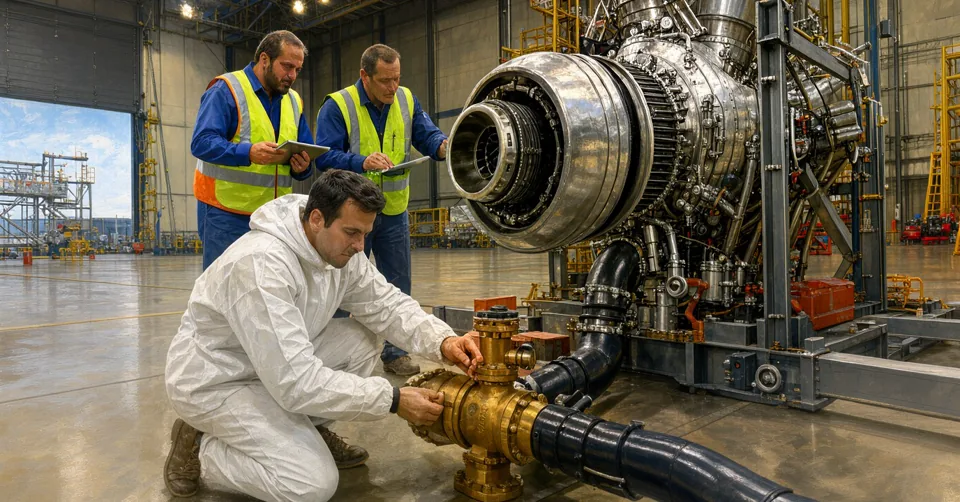
NASA tested RS-25 engine No. 10001 for 200 seconds on Nov. 18 at Stennis Space Center near Bay St. Louis, Mississippi. The developmental engine will not fly, but the test gives NASA and L3Harris data to improve performance and reliability for future Artemis missions. Four RS-25 engines will provide up to 2 million pounds of combined thrust for the SLS rocket on Artemis IV in 2028.
Voyager 1 reaches one light-day from Earth after 49 years
NASA's Voyager 1 reached one light-day from Earth at 2:16 a.m. PST on Nov. 18, a distance of about 16.1 billion miles. JPL heard from the spacecraft 24 hours later, using the carrier signal and trajectory calculations to confirm the milestone. The 1977 spacecraft continues to measure magnetic fields and plasma, and will examine solar effects as it travels farther from the Sun.
Astronomers find unusual triple-star system 28 light-years away
Astronomers led by the Trottier Institute at Université de Montréal found Welopōʻai, a triple-star system 28 light-years from Earth. It contains a red dwarf, a nearby white dwarf and a second, more distant white dwarf, with no comparable system within 100 light-years. The discovery, made using SPIRou and Gemini North while searching for planets around the red dwarf, challenges ideas about how stars evolve and interact.
Fiji and Tonga declare El Niño drought crisis in South Pacific
Fiji and Tonga have declared El Niño droughts at crisis level, with Fiji declaring a nationwide disaster and Tonga a 27 day state of emergency. Fiji's emergency measures allow water rationing, forced evacuations and reallocation of public funds, while trucks resupply villages as water sources fall. The drought threatens water, crops, livestock and health, and experts expect the current El Niño to become one of the most powerful on record.
Underwater station Vanguard helps restore Florida Keys coral
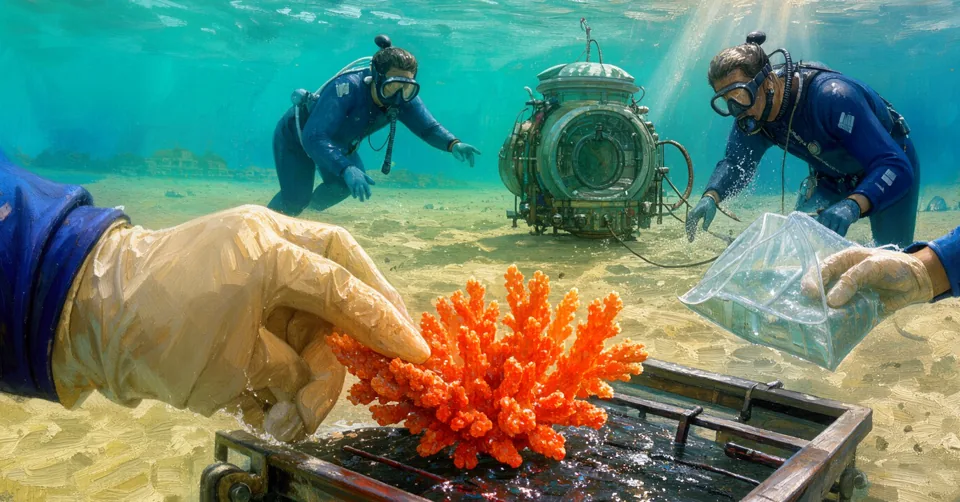
Vanguard, a long-stay underwater station deployed in June 2026 at Tennessee Reef in the Florida Keys, is giving marine biologists a base for around-the-clock research. A temporary coral nursery beside the station is helping corals moved from a shallower site recover in cooler, deeper water. The project aims to establish a more permanent nursery and eventually plant corals on the seabed as part of restoration efforts.
X-rays break both O-H bonds in water before electrons relax
A single X-ray photon can break both O-H bonds in an isolated water molecule within a few femtoseconds, producing a neutral oxygen atom before electronic relaxation is complete. Researchers at PETRA III and MAX IV used high-resolution electron spectroscopy and calculations to identify the excited oxygen atom from the emitted electron fingerprint. The finding points to similarly fast fragmentation routes in other small molecules exposed to X-rays.
Wreck of Australia's first locally built warship found 128 years on
Marine archaeologists found the wreck of Ex HMCS Spitfire, Australia's first locally built warship, off far north Queensland on 21 August, the anniversary of its 1898 sinking. The 19-metre wooden gunboat was built in Sydney in 1855 to guard against Russian warships during the Crimean war. A museum, government and navy team located it with sonar aboard HMAS Diamantina, adding a protected site to Australia's underwater heritage.
Cincinnati Zoo uses vibration plate to help Fiona pass knit cap
Cincinnati Zoo veterinarians are using a borrowed vibration plate to help Fiona the hippo pass a knit cap she swallowed more than a week ago. The cap entered her enclosure when a visitor tossed it and a ceiling fan pushed it through a small opening above the viewing windows. After a second sedation, ultrasound showed intestinal bunching and a colonoscopy was performed, while staff monitor her because surgery is not an option.
Horsehead and Flame Nebulas featured in NASA image
NASA's 19 November 2026 daily image shows the Horsehead Nebula, a dark dust-and-gas formation about five light-years tall and roughly 1,500 light-years away. The image also includes the Flame Nebula, the blue reflection nebula NGC 2023, and the bright blue star Alnitak in Orion's Belt. The data were collected for almost six hours at Utah Desert Remote Observatories and controlled remotely from Illinois.
Potatoes in simulated lunar soil match Earth-grown performance
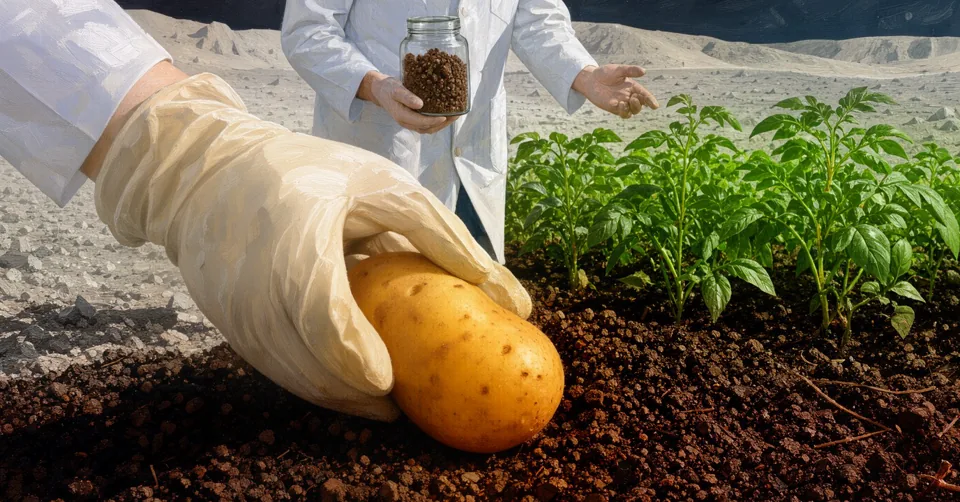
Oregon State University researchers found that potatoes can complete their life cycle in simulated lunar regolith amended with 30 percent vermicompost, matching growth and development in Earth soil. The plants were safe to eat, supporting NASA's Artemis goal of producing food on the moon rather than relying on costly resupply missions. Without organic matter, potatoes were stunted, showing that lunar soil needs added nutrients.
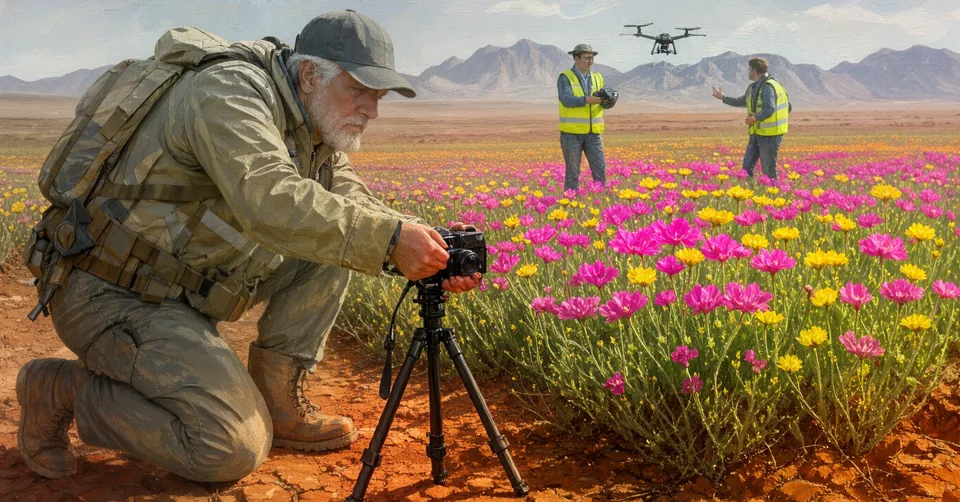
Unusually wet winter storms linked to a strengthening El Niño woke dormant seeds in parts of the Atacama Desert in northern Chile. The resulting austral spring 2026 flowering, visible in satellite images, may be the most extensive desierto florido of the satellite era. Scientists are using satellite data, drones and cameras to map the bloom's biodiversity for land-use and conservation planning.
Turmeric supplements show little benefit for knee osteoarthritis
A review of four randomised controlled trials involving more than 370 people with knee osteoarthritis found turmeric supplements had little to no effect on pain and mobility. Participants taking turmeric extract had a 2.3-point average pain reduction, compared with 1.6 points for placebo, a difference below the threshold considered meaningful. The supplements also showed no meaningful effect on quality of life or everyday activities.
Paramount+ offers two months of Star Trek for $2.99
Paramount+ is offering $2.99 per month for the first two months for Black Friday 2026 on Essential and Premium plans. The deal, which ends 30 November, includes access to 12 Star Trek series and 14 movies, including The Original Series, Discovery, Picard, Strange New Worlds and Starfleet Academy. After two months, prices rise to $8.99 for Essential and $13.99 for Premium, with cancellation allowed anytime.

 Illustration