Daily Summary of Science & Space · Final editionSunday 15 November 2026 · UTC
Science & Space News: 15 November 2026
Euclid finds 15,000 lens candidates as NASA warns of Monster El Niño
Euclid's first major data release yielded 15,000 new potential strong gravitational lenses, the largest collection yet, from 1.7 million gigabytes covering almost 5% of the night sky. NASA scientists say the 2026 El Niño is developing rapidly and could rival the powerful 1997-98 and 2015-16 events. Voyager 1 is also set to reach a light-day from Earth on Nov. 18, prompting a look at its 1979 Jupiter flyby.
Euclid data reveal 15,000 new strong lens candidates
Researchers have identified 15,000 new potential strong gravitational lenses in the first major data release from the European Space Agency's Euclid telescope. The release contains 1.7 million gigabytes and, after analysis by more than 2,000 scientists, reveals more than 900 million galaxies and 60 million quasars across almost 5% of the night sky.
The lenses can help study dark matter, which, with dark energy, makes up roughly 95% of the universe.
Spacecraft eclipse power data may help track lunar orbits
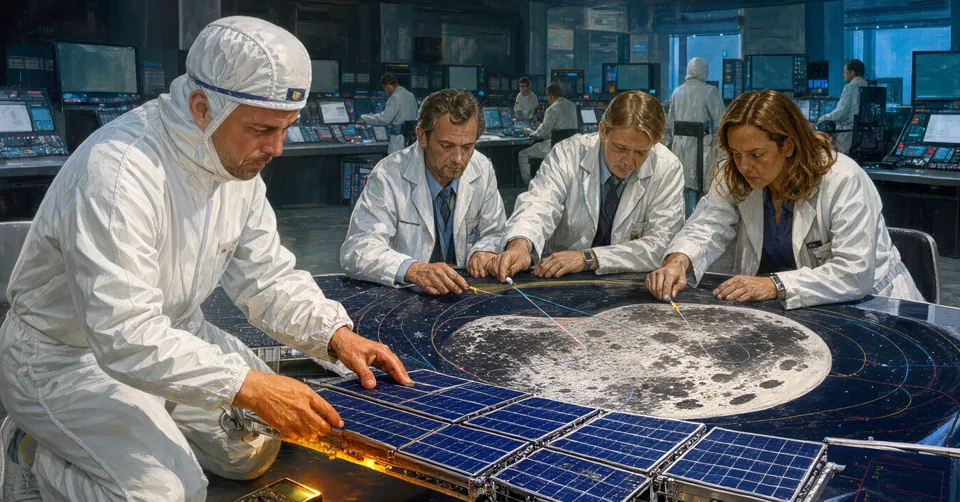
Researchers propose using solar array output during spacecraft eclipses to determine positions in lunar orbit. Ian Down, James McElreath and Manoranjan Majji say the method is no-cost because spacecraft already track panel power, and eclipse timing can reveal where the craft is. The approach could ease pressure on NASA's Deep Space Network, which is being overwhelmed by tracking requests.
Comet 220P/McNaught brightened thousands of times after gas outbursts
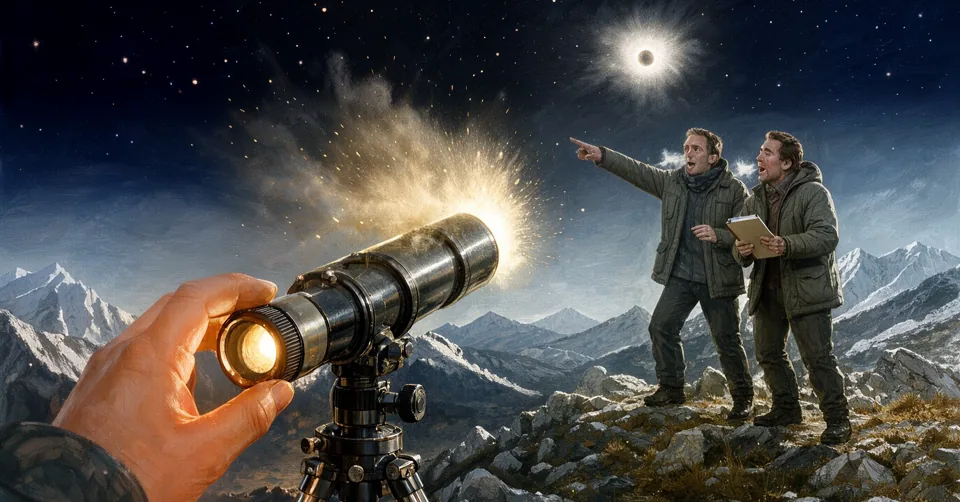
Comet 220P/McNaught brightened from magnitude +17.39 to +11.05 in less than 14 hours on 31 May, making it visible to small telescopes. By 2 June it reached magnitude +8.23, and a second outburst in late July raised it to magnitude 6.1 by 6 August. Models say solar heating turned subsurface ice into gas, whose pressure ejected tens to hundreds of billions of pounds of dust and made the comet thousands of times brighter.
Cambridge team catches quantum vortices unraveling in ultracold gas
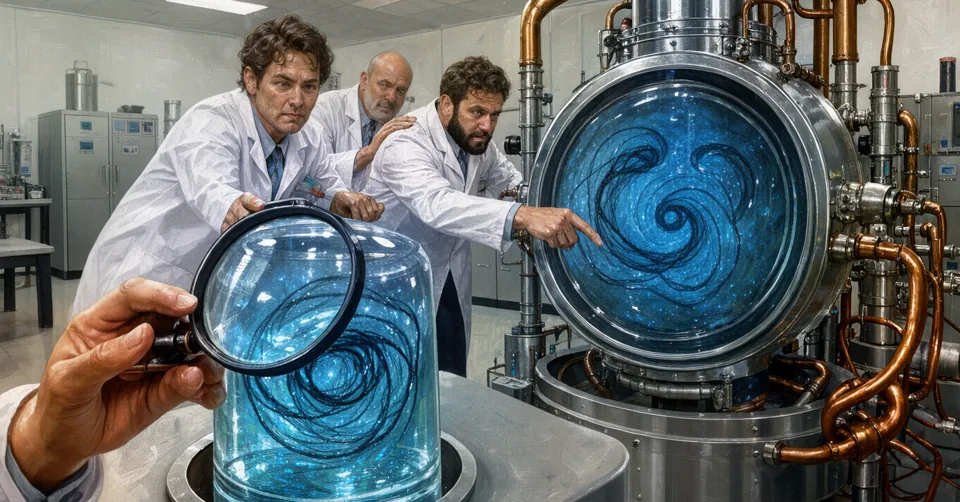
Researchers led by Sebastian Morris at the University of Cambridge directly observed the decay of vortex tangles in a Bose-Einstein condensate of potassium atoms. Using a new imaging method, they photographed thin slices of an enlarged ultracold gas and estimated how vortex density shrank as the system relaxed. The result confirms the theory of Vinen turbulence, in which denser vortex tangles decay faster.
Voyager 1's Jupiter photos changed our view of the solar system
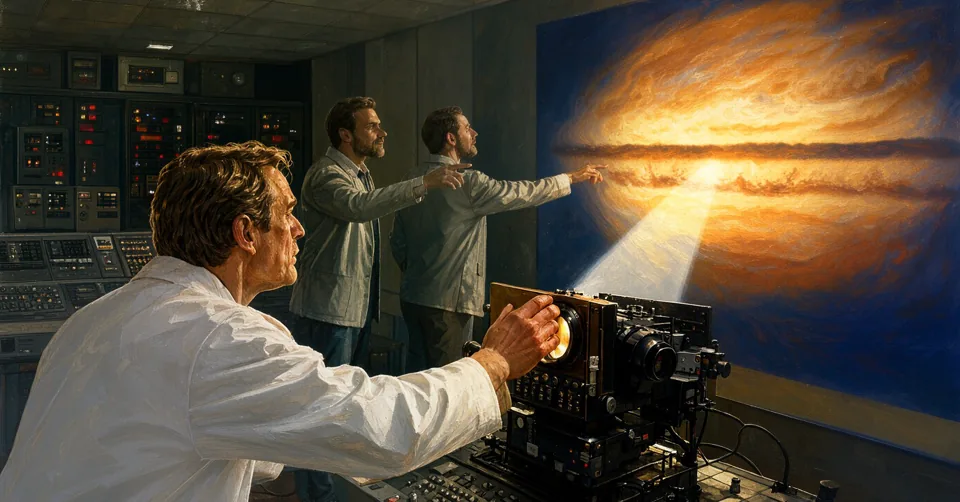
Voyager 1's 1979 Jupiter flyby is being revisited as the probe is set to reach a light-day from Earth on Nov. 18. The probe photographed Jupiter every 96 seconds, creating a time-lapse of swirling bands, storms and clouds that showed the atmosphere was far more dynamic than previously thought. It also detected a thin, faint dust ring system visible only when backlit by the Sun.
Giant prehistoric rodent fossils found in southern Thailand
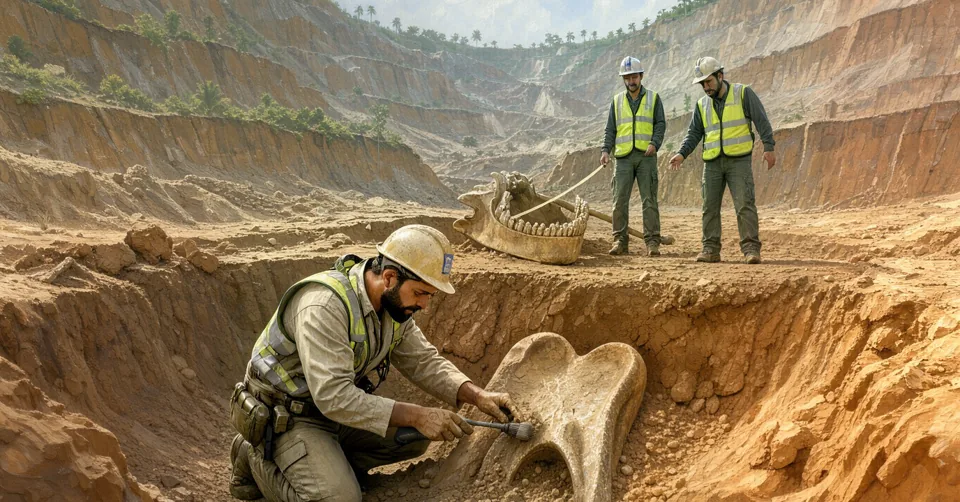
Paleontologists found large rodent fossils in a mine pit in southern Thailand and named the new species Yakamys sirindhornae. The animal lived about 34 million years ago, and dental estimates suggest it weighed roughly 30 kilograms, about twice the size of other known rodents from that era. The find shows large-bodied rodents were older and more widespread than previously recognized.
New observations challenge evidence for outsize black hole in early universe
A reanalysis of UHZ1 using existing X-ray data and new infrared observations challenges a previous claim that it hosts an unusually massive black hole in the early universe. Led by Fan Zou of the University of Michigan, the study reports no signs of hidden black hole activity and suggests UHZ1 could be a low-mass, metal-poor, star-forming galaxy. The earlier interpretation relied on a weak X-ray signal that depended heavily on image alignment.
New study may explain Uranus and Neptune's tilted magnetic fields
A new study suggests changes in electrical conductivity under extreme conditions may explain the distorted, tilted magnetic fields of Uranus and Neptune, first seen by Voyager 2 in the 1980s. The work, led by the University of Texas at Austin, points to dynamo processes deep inside the ice giants. It also raises the possibility that their magnetic fields could change dramatically over just a few decades.
White dwarf in Sun-like pair traced as source of radio pulses
Researchers at Curtin University's ICRAR traced puzzling radio pulses to a pair more than 5,000 light-years away, containing a white dwarf that spins every eight minutes and a Sun-like companion. The system is the first long-period transient identified with a white dwarf orbiting a Sun-like star rather than a red dwarf. Observations followed the white dwarf in orbit, pointing to the pulses as coming from near it, possibly the white dwarf itself.
ALMA resolves three dense cores at different stages in one star-forming clump
Researchers using ALMA data resolved the massive star-forming region G40.282-0.219 into three dense cores, MM1, MM2 and MM3, inside the same parental clump. The cores differ in mass, molecular content, outflows and dust temperature, with MM1 appearing youngest and MM3 most evolved. The result sheds light on physical and chemical differences among cores within the same massive dense clump.

 Illustration