Daily Summary of Science & Space · Final editionFriday 20 November 2026 · UTC
Science & Space News: 20 November 2026
BepiColombo reaches Mercury as CERN reports rare decay and a Riemann proof is claimed
BepiColombo has reached Mercury and will enter orbit Saturday, becoming the second spacecraft to circle the planet. CERN reported evidence for a rare Bd to mu mu decay after more than 40 years of searching, and an Anthropic mathematician claimed an AI-assisted proof of the Riemann hypothesis. Researchers also 3D printed interlocking bricks from simulated lunar dust without binders.
Perseverance and Odyssey pause science work over glitches
NASA said Perseverance and the Mars Odyssey orbiter have stopped science work after Perseverance had an antenna problem and Odyssey had a reaction wheel issue. Perseverance is now sending data directly to Earth at lower rates while the mission team prioritizes diagnostics. NASA hopes both spacecraft can resume by the end of November.
Levent Alpöge at Anthropic claims to have discovered, with the aid of Claude AI, a proof of the Riemann hypothesis, an 1859 problem about prime numbers and one of the Clay Mathematics Institute Millennium Prize Problems. He released a Lean formalisation for mechanical checking, while an unpublished version reportedly ran to more than 250,000 pages. Mathematicians say the code and mathematics still need thorough human review.
Webb confirms first observed giant star swallowing companion
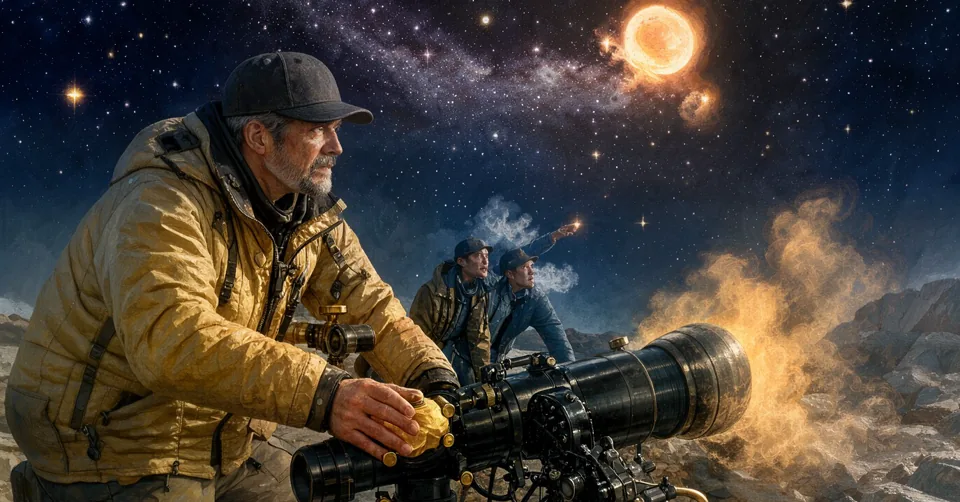
Astronomers using the James Webb Space Telescope confirmed the first recorded merger of a supergiant star and a smaller companion in the Andromeda galaxy. The binary, dubbed Bao, was first noticed brightening in 2023, and later observations showed dust. The smaller star struck the supergiant in 2018 and was drawn into its core in under seven years, releasing a large burst of energy. It is a rare direct view of stellar mergers.
Independent team verifies first image of M87 black hole
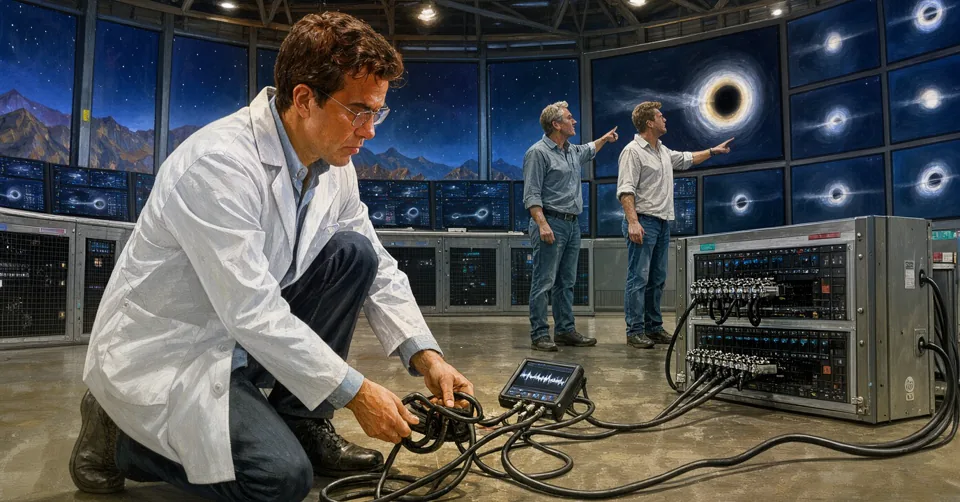
An independent team led by CSIRO researcher Samuel Lai has validated the 2019 Event Horizon Telescope image of the supermassive black hole M87*. Using a machine-learning method called GenDIReCT, the team filtered atmospheric interference and interferometer biases and found a black hole almost identical in size and shape. The result is described as the first truly independent validation of the image and supports Einstein's general relativity.
SpaceX Dragon to undock from ISS for Pacific splashdown
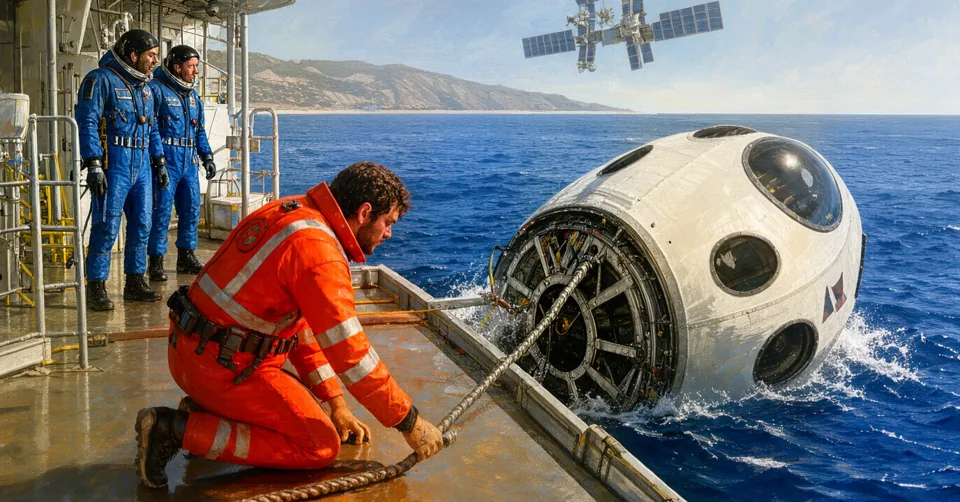
SpaceX's Dragon cargo capsule, mission CRS-35, is scheduled to undock from the International Space Station today and splash down in the Pacific off California on Saturday. It launched Oct. 13 and delivered more than 6,300 pounds of supplies to the station. It will return thousands of pounds of cargo, including a 3D-bioprinted blood vessel construct used to study vascular aging, and is the only cargo craft flying today that can return cargo.
ALMA captures gas ring and hourglass around dying star
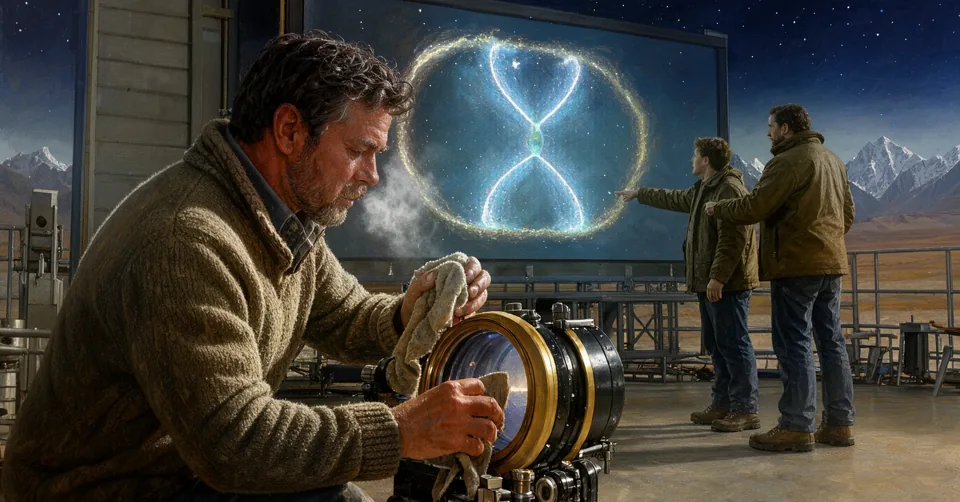
ALMA images of the star IRAS 06530-0213, about 12,000 light-years away in Monoceros, show a giant gas ring about half a light-year across and an hourglass-shaped nebula taking shape. A JPL-led team estimates the ring was blown off about 6,500 years ago, calling it the first direct evidence of a star's last thermal pulse before its final phase. The finding captures the brief transition between a red giant and a planetary nebula.
Keck data link Europa's stable sodium cloud to its ocean
Observations from W. M. Keck Observatory show that the diffuse sodium cloud around Jupiter's moon Europa has remained stable for more than two decades. The study, led by Boston University and published in the Journal of Geophysical Research: Space Physics, links high-altitude sodium to sodium near Europa's visible disk. The stable abundance suggests the material originates in Europa's saltwater rather than in volcanic activity from Io.
Arkansas team 3D prints interlocking bricks from lunar dust simulant
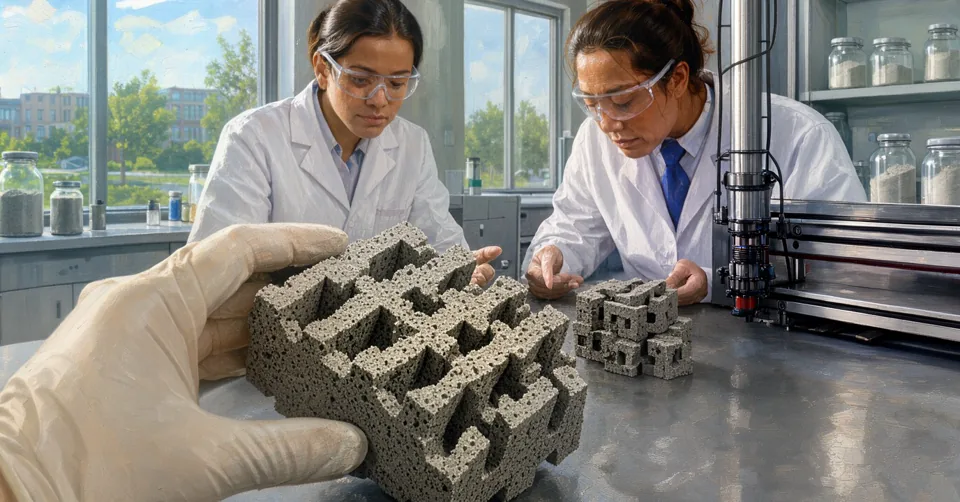
University of Arkansas researchers used laser powder bed fusion to 3D print simulated lunar dust into interlocking, LEGO-like bricks without adding a binding agent. The team became the first to directly fuse a lunar regolith simulant into reconfigurable construction blocks, potentially letting future lunar bases make building materials on the Moon and reduce supplies shipped from Earth.
CERN finds evidence for rare Bd to mu mu decay after 40-year search
Physicists at CERN report evidence for the rare Bd to mu mu decay, in which a particle containing a beauty quark turns into two muons, from the upgraded LHCb experiment. The signal has 3.2 sigma significance, enough for evidence but not yet a discovery, after more than 40 years of searching. The result may help test the Standard Model and reveal unknown particles or forces.
Xavier becomes strongest November storm east of international date line
Tropical Cyclone Xavier rapidly intensified in the Southwest Pacific and reached peak winds of 220 kilometers per hour, making it the strongest November storm east of the international date line on record. The system, the basin's second named storm of the season, developed near the Cook Islands amid El Niño conditions and damaged homes and disrupted power there before weakening westward.
Milky Way bar shocks may drive unusual star formation
A University of Sydney Ph.D. student has found evidence that the Milky Way forms new stars unusually near its central bar, where shock fronts compress gas clouds. The rotating bar drives those shocks, and the finding, published in Nature Astronomy, challenges ideas about the galaxy's structure. It also raises questions about the existence of the Norma spiral arm.
Europe says Africa should use pledged climate money
Drought in Uganda and flooding in Malawi show the effects of climate change on communities, while 23 African countries have not yet submitted National Adaptation Plans to the UN climate convention secretariat. Experts say the missing plans make it harder to secure funding, and Europe says Africa should use what is already pledged.
Massive star winds may feed Milky Way's supermassive black hole
An international team led by MPE says observations and simulations trace compact gas clouds near Sagittarius A* to powerful winds from a massive pair of stars. The clouds, including G2, G1 and G2t, may be dense parts of a continuous stream, called the G1-2-3 streamer, that could help feed the Milky Way's central black hole. The finding offers a possible source for gas seen moving close to the supermassive black hole.
BepiColombo reaches Mercury and will enter orbit Saturday
The joint European and Japanese BepiColombo probe has reached Mercury after more than eight years and 6bn miles, and flight controllers will fire thrusters Saturday to put it into orbit. It will become the second spacecraft to circle the planet, with the European and Japanese orbiters separating in early December to map its surface, study its unusually large core and measure its magnetic field.

 Illustration