Daily Summary of Science & Space · Final editionTuesday 17 November 2026 · UTC
Science & Space News: 17 November 2026
CERN probes zeptoverse as Leonids peak and black holes hint at failed supernovas
Physicists at CERN detected a rare particle interaction that opens a view of the zeptoverse, while gravitational-wave data suggest some black holes formed when massive stars failed to explode. The Leonid meteor shower peaks Tuesday night, with the best viewing after midnight when Leo rises and the Moon sets. The 60th anniversary of the 1966 Leonid storm is also being marked.
Gravitational waves hint at black holes from failed supernovas
Gravitational-wave data from LIGO, Virgo and KAGRA suggest some black holes formed when massive stars failed to explode as supernovas. A team led by Katerina Chatziioannou of Caltech analyzed the masses of 257 black hole mergers detected over the past 10 years and found a peak at about 10 solar masses. Those black holes made up 75 percent of the sample, suggesting a distinct subpopulation born from failed supernovas.
NASA NICER ends science operations after motor issue
NASA's NICER X-ray telescope on the International Space Station has ended science operations after six and a half years beyond its initial mission. Engineers think an internal motor has failed, limiting its side-to-side motion, and teams are planning to finalize an 8-year archive before decommissioning and detaching it. NICER, launched in 2017, made measurements of neutron stars and revolutionized understanding of black holes and active galaxies.
CERN LHC detects rare 1-in-10-billion particle interaction in zeptoverse
Physicists at CERN's Large Hadron Collider have detected a rare 1-in-10-billion particle interaction in a study of beauty quarks, giving the first view of the zeptoverse, scales below a hundred-trillionth of a visible-light wavelength. The preprint, announced Nov. 3 and not yet peer reviewed, says such tiny distances may reveal new particles and help explain dark matter and the universe's matter-antimatter imbalance.
NASA to release first Roman Space Telescope images at AGU meeting
NASA will release the first images from the Nancy Grace Roman Space Telescope in a live stream from the AGU Annual Meeting in San Francisco at 3:30 p.m. EST on Monday, Dec. 7. The images will show deep, panoramic, never-before-seen views of the universe to explore dark energy, dark matter and worlds outside the solar system. On Dec. 8, the public can claim a personal pixel from a selected first image and receive a digital trading card.
Curiosity data hints at small amounts of surface water on Mars
A study in the Proceedings of the National Academy of Sciences used more than a decade of Curiosity data to test whether daily and seasonal changes in Mars' carbon dioxide-rich atmosphere can be explained by known processes. The isotope record from Gale Crater suggests water may be involved, either attached to soil grains or in extremely thin, liquid-like surface films. This adds to evidence about how Mars' atmosphere interacts with its ground.
ISS astronauts 3D print human cells and tissues in microgravity
NASA astronaut Jessica Watkins is working on an ISS experiment that mixes living cells with bioink and 3D prints them in the station's Life Sciences Glovebox. The InSPA-Auxilium Bioprinter-Cell Printing study uses microgravity to make human liver, kidney and cartilage tissue. It aims to improve biology, medicine and engineering research and one day support patients in space and on Earth.
China opens payload calls for Tianwen-4 Callisto landing mission
China's CNSA has opened calls for instruments for Tianwen-4, a Jupiter mission whose primary goals are Jovian orbiting and orbiting and landing exploration of Callisto. The orbiter will carry 10 instruments, while the lander is planned for a Raman spectrometer and magnetometer to study the moon's ice, rock and carbon. The mission is not a sample return but could clarify Callisto's surface composition.
Astronomers have detected SN 2026ahvu, a Type Ia supernova in the spiral galaxy NGC 1433, about 50 million light-years away. It was found on Nov. 2 by ATLAS, a survey designed mainly for near-Earth objects, and recorded early enough for detailed follow-up. In one Type Ia path, a white dwarf draws material from a companion star until it reaches the Chandrasekhar limit and is destroyed.
Satellite traffic can outnumber visible stars over most mid-latitude towns
An analysis of 15,833 active low Earth orbit satellites found 710 crossing the sky over an average U.K. town in every moment of a night, often outnumbering naked-eye stars. The non-peer-reviewed study by Accu Components used U.S. Space Force data and says similar traffic affects much of Europe, the U.S. and other mid-latitudes. On average, 105 of the 710 were sunlit and star-bright, rising to about 300 after dusk and before dawn.
Webb links galaxy outflows to star formation at cosmic noon
NASA's James Webb Space Telescope has observed a link between powerful gas outflows from massive galaxies and the quenching of star formation at cosmic noon, roughly 8 to 12 billion years ago. The outflows, driven by supernovae or supermassive black hole outbursts, can remove or heat the cold gas needed for new stars. A paper in Astrophysics and Space Science says the outflows are more abundant and powerful than previously thought.
New Z2^2-graded supersymmetric Yang-Mills theory shows no ghostlike instabilities
Researchers constructed a minimal Z2^2-graded classical supersymmetric Yang-Mills theory and derived its invariant action. They showed all kinetic terms have the standard sign, indicating no classical ghostlike instabilities, and that the Hamiltonian's positivity follows from the graded supersymmetry algebra. The work does not report a new particle but points to broader possible particle symmetries.
Satellite image shows green-appearing herring sperm cloud off Vancouver Island
A satellite photo captured an underwater cloud of Pacific herring milt that appeared to glow green during a spawning event off Vancouver Island. The cloud, about 4 miles long, was visible for around 48 hours at a reproductive sweet spot in Barkley Sound, roughly 45 miles north of the U.S. border. The substance is actually white, and scientists are using satellite images to monitor such spawning events.
New technique tests cosmic microwave background twist
Physicists at UC San Diego developed a technique, tested with ESA Planck data, to check how accurately telescope detector groups measure polarization angles. The method addresses a key obstacle to confirming cosmic birefringence, a possible slight rotation in the cosmic microwave background that could point to physics beyond the Standard Model and offer clues about dark matter and dark energy.
DESI puts Milky Way mass at 1.19 trillion times the sun's mass
The Dark Energy Spectroscopic Instrument Collaboration has made the most precise measurement yet of the Milky Way's mass, placing it at 1.19 trillion times that of the sun with about 11 percent uncertainty. The team analyzed more than 10,000 distant stars from DESI's first three years and combined their motions with Gaia space telescope data. The result follows earlier estimates that differed widely.
Hera begins surveying Didymos and Dimorphos after DART impact
ESA's Hera has reached the Didymos-Dimorphos system and begun its early characterization phase about 25 to 30 kilometers from the asteroids. The car-sized spacecraft will use visible, multispectral and thermal infrared instruments to study the pair, including Dimorphos after NASA's 2022 DART impact. Because the asteroids' gravity is extremely weak, Hera flies nearly straight paths with 90-degree thruster turns, creating rectangular orbits.
Japan's Hayabusa-2 changes asteroid target after engine trouble
Japan's Hayabusa-2 probe, which returned asteroid Ryugu dust to Earth in 2020, is changing its extended mission target because of repeated main engine malfunctions. It will now aim for a flyby of asteroid 2015 BM510 in April 2028 instead of 1998 KY26, which it had planned to reach in 2031. The new target is a dark asteroid 17 to 74 meters across that rotates every 49 minutes, and the mission could help future planetary defense efforts.
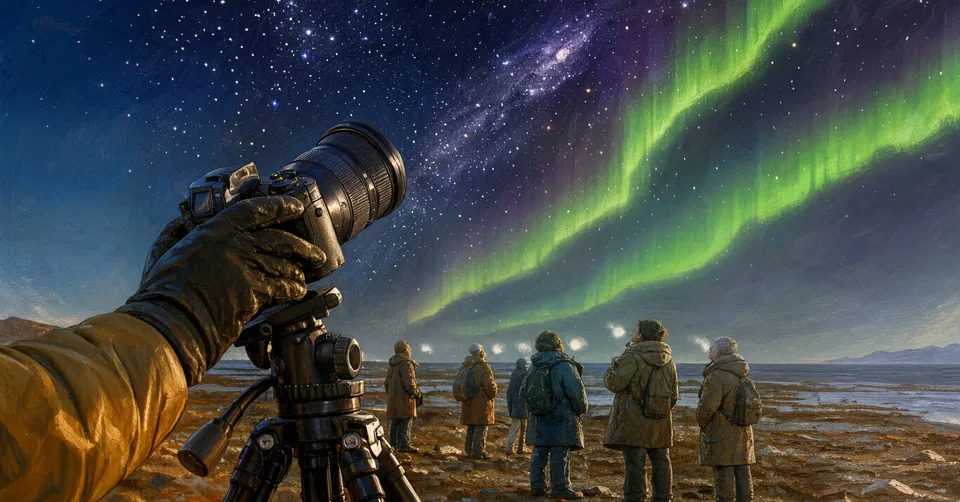
Milky Way and aurora appear as arches in Norway image
An image taken about a month ago from Kvaløya in northern Norway shows the Milky Way's central band and an auroral ribbon as two arches. The Milky Way is an ancient system of stars, gas and dust that predates Earth, while the aurora is hours old and formed in Earth's upper atmosphere by energetic particles from the Sun. The Big Dipper lies behind the auroral arch, and the Andromeda galaxy is a bright spot near the top of the frame.
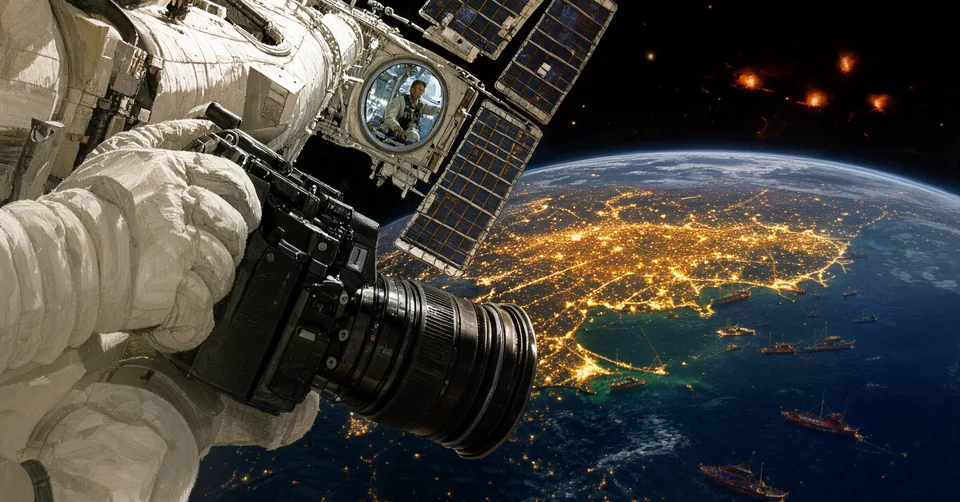
Space station image shows lightning, Singapore lights and fishing boats
NASA astronauts have described Earth's night view from the International Space Station, with lightning among the most spectacular sights. On October 28, 2026, the station passed over the South China Sea near Borneo at 14:20 UTC, and an astronaut captured the scene with a Nikon Z9 camera. The image shows Singapore, likely fishing-boat lights west of the city and likely gas flares offshore to the northwest.
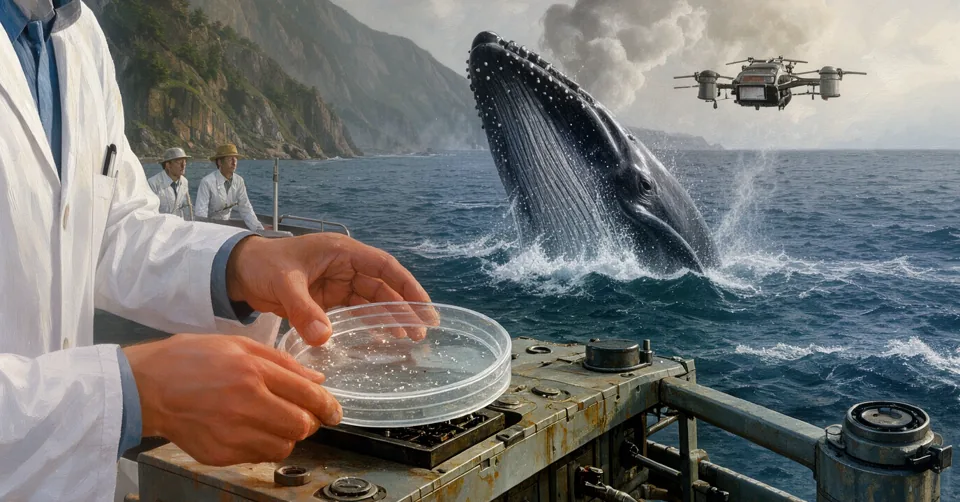
Humpback whale genome sequenced from drone-collected snot without biopsies
Researchers sequenced a whole humpback whale genome from sterile petri dishes attached to a drone that flew through the whale's exhaled breath. The study in Molecular Ecology Resources collected 58 blow samples from 26 whales off British Columbia, with about 84 percent of the DNA coming from the whale. Matching repeat and biopsy results show the method can provide genomic data without darts, biopsies or close boat approaches.
Black hole ringdown behavior matches general relativity
A team of more than 70 researchers used computer models and a literature review to study the ringdown phase of merging black holes. Their study in Classical and Quantum Gravity found that hundreds of observed mergers show ringdown behavior matching Einstein's theory of General Relativity. The authors say current methods have limits, but next-generation ground-based gravitational wave detectors could enable more accurate observations.
Slower-moving dark matter particles may be trapped in planets and stars
Dark matter has not been directly detected, but slower-moving particles may be too faint for detectors and more easily captured by planets and stars. A study by Alejandro Ibarra, Merlin Reichard and Gaurav Tomar considered Earth, the sun, Jupiter and white dwarfs and found no evidence of dark matter but ruled out some combinations of its possible properties.

 Illustration