Daily Summary of Science & Space · Live edition, updated continuouslySunday 22 November 2026 · UTC
Latest Science & Space News Today: 22 November 2026
JWST finds early black hole too heavy for host as study hints black holes may split
Astronomers using JWST, Hubble and Very Large Telescope data identified a possible 3.3-million-solar-mass black hole in a galaxy seen about 12 billion years ago, suggesting early black holes may grow faster than their host stars. Researchers proposed that fast-spinning black holes could split into smaller black holes under very specific conditions.
A Milky Way simulation combining three supercomputers and an AI model reached individual-star resolution.
Study hints fast-spinning black holes may split apart
Researchers published a paper in Physical Review D on Oct. 22 proposing that fast-spinning black holes could split into smaller black holes under very specific conditions. They explored whether event horizons could split in four-dimensional general relativity, higher-dimensional space-time and modified gravity. In classical general relativity the split appears mostly impossible, but the researchers found a possible loophole.
JWST finds possible early black hole that grew faster than its host galaxy
Astronomers using JWST spectroscopy, Hubble imaging and Very Large Telescope MUSE data identified a possible black hole in MARTA 3887, a clumpy, metal-poor galaxy seen about 12 billion years ago. The object appears to weigh about 3.3 million solar masses, while its host contains roughly 145 million solar masses in stars. The paper, posted to arXiv, says such overmassive early black holes may have grown faster than their host stars.
Gemini image of NGC 7253 shows interacting galaxies forming new stars
A new image from the Gemini North telescope on Mauna Kea shows NGC 7253, a pair of interacting spiral galaxies 200 million light-years away in Pegasus. Their mutual gravity is distorting their spiral arms and compressing cold gas, producing bright H II regions where hot young stars are forming. The encounter may eventually merge the galaxies, and Hawaii high school students gave the image the name Nā 'Uhane Māhoe Huki Pū i ke Ola.
Hybrid nanocrystal metasurface reveals new way to tune infrared light
A one-crystal-thick metasurface made from randomly mixed indium tin oxide nanocrystals, doped with 1% or 3% tin, can amplify or suppress infrared light beyond the sum of its parts. Infrared light excites plasmons that trap energy on the nanocrystals and in gaps between them. Mismatched electron waves from neighboring crystals can boost or suppress that energy, and the team's model can guide doping levels and mixing ratios.
Red Cross warns autonomous weapons development appears to outpace regulation
The International Committee of the Red Cross and rights groups warned that autonomous weapons development appears to outpace efforts to regulate them. The warning came as more than 120 member states of the UN Convention on Certain Conventional Weapons concluded a week-long conference in Geneva. The conference ended with an agreement to discuss a regulatory instrument over the next two years, which rights groups said fell short of urgent action.
Milky Way simulation reaches record resolution with three supercomputers
A team including researchers from the University of Tokyo simulated the Milky Way to individual star detail by combining three powerful supercomputers with an AI accelerated model. The AI predicted how gas around supernova explosions evolves, reducing the computing needed for rapidly changing dense regions. The paper was presented at SC 2026 in Chicago and may improve understanding of galactic evolution.
Parasite makes infected mice more attractive to blood feeding bugs
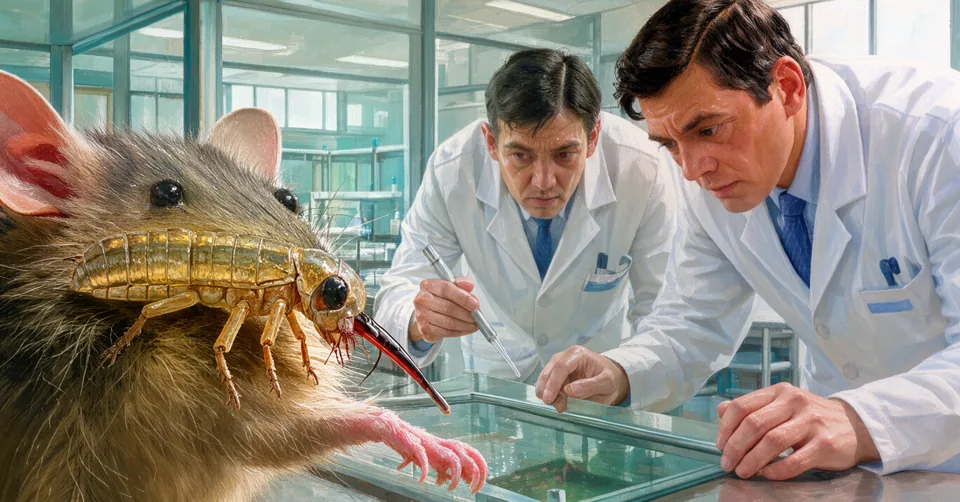
Researchers at Fiocruz in Brazil and INBIOTEC-CONICET in Argentina found that mice infected with Trypanosoma rangeli were more attractive to Rhodnius prolixus nymphs than healthy mice. Infected mice also preyed less on approaching bugs, and nearly half of the bugs that survived feeding transmitted the parasite. The study, published in Proceedings of the Royal Society B, suggests infection can help the parasite spread.
Record 111 sightings of rare Fisher's estuarine moth in Essex
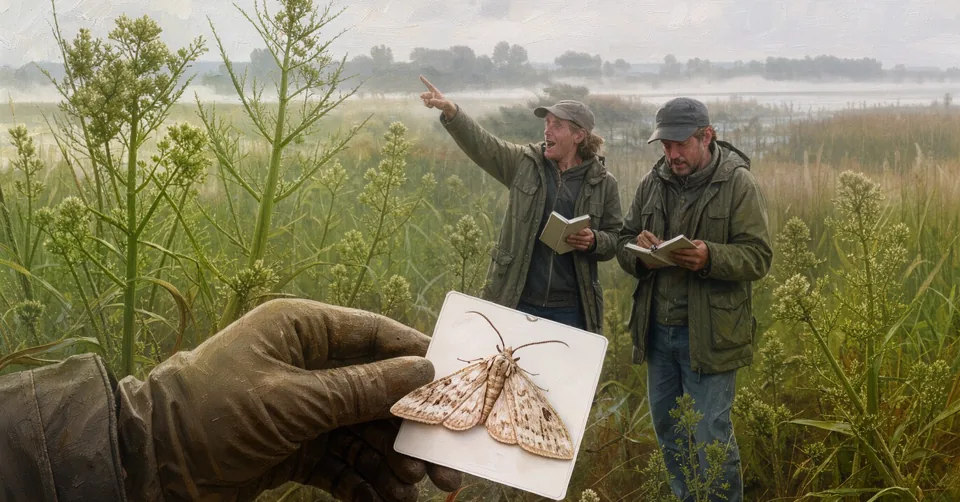
Fisher's estuarine moths were recorded 111 times at Abbotts Hall in Great Wigborough, near Colchester, in 2026. Dr Zoe Ringwood, of Essex Wildlife Trust, said work to boost the highly threatened species' population had been an important success story. The charity planted hog's fennel at the reserve in 2005 and introduced moth eggs in 2010, and now believes there is a self-sustaining population.
NASA's Juno image highlights unknown colors of Jupiter clouds
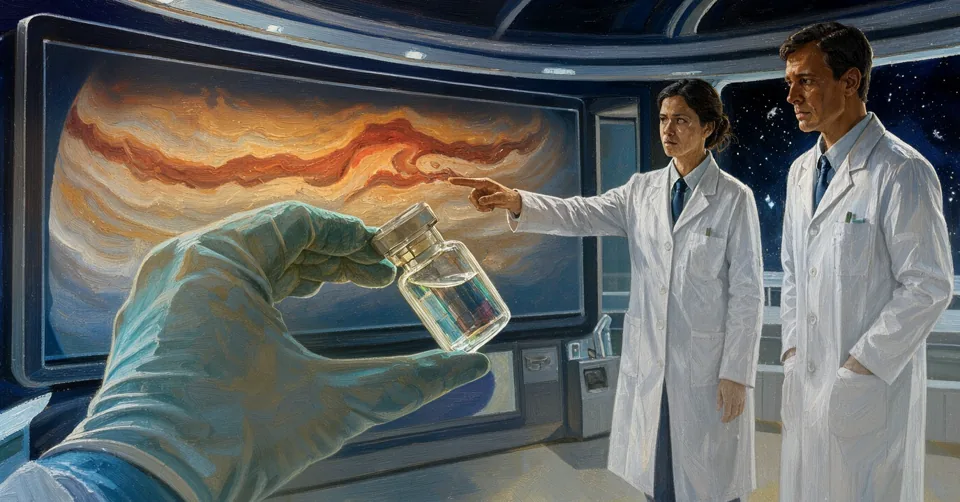
NASA's Astronomy Picture of the Day featured a color-enhanced image of Jupiter taken by the Juno spacecraft in 2018 during its 14th low pass. The image shows lighter clouds swirling around reddish regions and covering some darker areas, while the source of Jupiter's cloud colors remains unknown. Scientists are researching trace molecules, with small amounts of ammonium hydrosulfide one leading candidate.


 Illustration