Daily Summary of Science & Space · Final editionWednesday 4 November 2026 · UTC
Science & Space News: 4 November 2026
Altermagnetism confirmed as LHCb sees zeptoverse and ozone hole grows
Scientists confirmed altermagnetism, a third type of magnetism, while LHCb reported the first evidence of a rare beauty quark decay at zeptoverse scales. NASA and NOAA said the 2026 Antarctic ozone hole was the seventh largest in 48 years but the ozone layer remains on track for recovery. El Niño has fueled an intense typhoon season across East Asia, with accumulated cyclone energy expected to be nearly double the 30-year average.
China outlines two-launch crewed Moon landing plan
China's crewed space program said it plans to send the Lanyue lunar lander and Mengzhou crewed spaceship to the Moon on two Long March 10 launches, where they will rendezvous in orbit. Two of the three taikonauts would transfer to the lander and descend to conduct science operations. The plan was presented by Wang Xiang at the 7th Manned Space Symposium and follows milestones that put a crewed lunar mission on track for 2030.
Mars gas hints at magma and possible habitable vents
Europe's ExoMars Trace Gas Orbiter detected a possible signal of hydrogen chloride gas leaking from rifts near Alba Mons, the largest Martian volcano by surface area. Scientists interpret the gas as emissions from hot magma below the regolith, suggesting an environment similar to Earth's hydrothermal vents. The study, published in Science Advances, is the strongest evidence yet of gases released by dormant volcanoes on Mars.
NASA's Swift telescope falls to Earth after failed rescue
NASA's Swift Gamma-Ray Burst Explorer reentered Earth's atmosphere over northern Sumatra on Nov. 4, 22 years after launch and three months after a private spacecraft was to boost it. The 3,200-pound observatory was expected to mostly burn up, with a 1 in 2,100 chance of surviving pieces hurting someone. Swift had studied gamma-ray bursts and other cosmic bodies until its final science observation on Oct. 20.
NASA awards Ka-band satellite relay concepts to three firms
NASA selected three companies on Wednesday to develop Ka-band space relay capability concepts compatible with current missions in space. The firm-fixed-price contracts run from Nov. 4 through May 3, 2027, with options through 2029 to advance from concept development to an in-orbit flight demonstration. The work supports NASA's plan to retire the Tracking and Data Relay Satellite fleet and adopt commercial services without modifying spacecraft.
Artemis II launch disrupted GPS through ionosphere
NASA's Artemis II launch in April 2026 caused significant ionospheric disturbances that could produce temporary, localized GPS errors of several meters, a study found. Researchers at National Cheng Kung University said the disturbances were more significant than any other rocket launch to date and up to ten times more intense than those after SpaceX Starship test launches.
NASA drone test shows promise for planetary landings
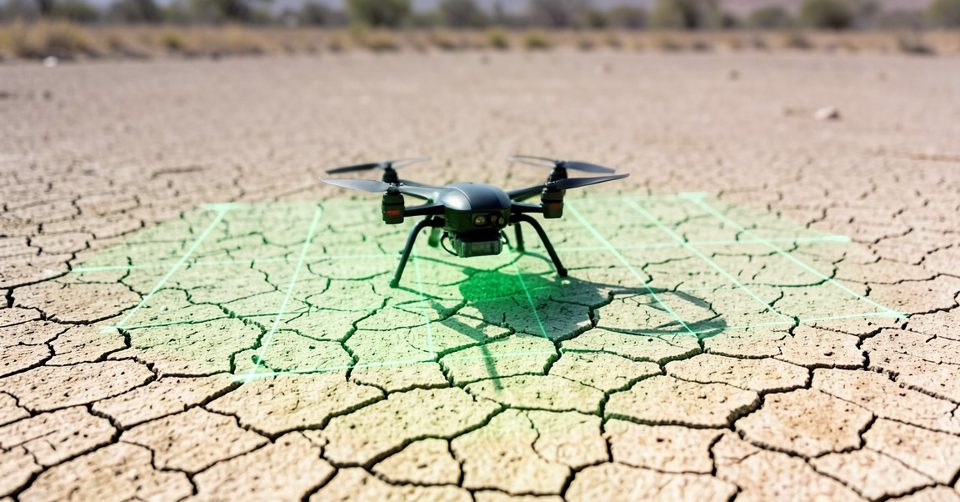
NASA demonstrated technology to help spacecraft autonomously navigate to safe landing sites on the Moon and other planets. An Alta-X drone carrying the SPLICE payload completed simulated lunar descent and landing maneuvers on Aug. 27 at Rogers Dry Lake near Armstrong Flight Research Center. The system mapped terrain, assessed landing areas, and could divert the drone to a safer location, raising its readiness for future lunar flights.
Giant impacts may help rocky planets keep atmospheres
A new study in Nature Astronomy suggests that giant impacts during the late formation of rocky planets may have helped them retain primordial atmospheres. Researchers Darius Modirrousta-Galian and Jun Korenaga say impacts drive some heat deep into the planet and can increase atmospheric gravitational binding, rather than only heating the surface. The work addresses how young Earth-like planets retained atmospheres despite collisions.
NASA and NOAA report 2026 Antarctic ozone hole is large but recovering
NASA and NOAA say the 2026 Antarctic ozone hole ranked seventh largest by area in 48 years of monitoring, with a peak one-day extent of 10.5 million square miles on Sept. 18. An unusually powerful polar vortex allowed the hole to grow, but the ozone layer remains on track for long-term recovery. The hole could have been 1 to 2 million square miles larger if ozone-depleting substances were as prevalent as in 2000.
A giant planet has emerged from two-year-old data from NASA's James Webb Space Telescope thanks to a glare-removal technique. JWST can look billions of years into the past but struggles to photograph planets orbiting nearby stars because their stars' brightness overwhelms the planets' faint glow. The technique addresses one of the telescope's blind spots for nearby planetary systems.
Southern Taurid meteor shower peaks overnight with fireball chance
The Southern Taurid meteor shower's fireball swarm component is expected to peak overnight on Nov. 4 to 5, according to the American Meteor Society. The minor shower is expected to produce up to five meteors per hour, and occasional fireballs can be at least as bright as Venus. The radiant lies in Taurus, so the best viewing is around midnight from a dark sky, with the Northern Taurids peaking on Nov. 11 to 12.
MIT breaks a 20-year rule with flexible nanoparticle connectors
Researchers at MIT and collaborators say extremely flexible molecular connectors can guide nanoparticles into crystal structures never observed before. The approach contradicts two decades of thinking that rigid connectors are needed for reliable nanoparticle assembly. The findings, to appear in Nature Materials, may help design materials for electronics, medicine, energy technologies, agriculture and chemical manufacturing.
Varda launches three space capsules to grow cancer drug crystals in orbit
Varda Space Industries has launched three capsules into orbit, marking the first time multiple commercial re-entry vehicles have been in space simultaneously. One capsule is growing crystals of a potential cancer drug in microgravity, a process that could produce more ordered structures than on Earth. The company aims to build a fleet of orbiting pharmaceutical factories to manufacture drugs and semiconductors with fewer defects.
SLAC confirms altermagnetism as a third type of magnetism
Scientists at SLAC National Accelerator Laboratory say they have confirmed altermagnetism, a third magnetic phase distinct from ferromagnets and antiferromagnets. In a study in Science, the team found direct evidence of chirality in manganese telluride, a material long classified as an antiferromagnet. The result could help develop magnetic materials for memory systems, quantum devices and more energy-efficient data centers.
NASA features image of hidden galaxy IC 342 through Milky Way dust
NASA's Astronomy Picture of the Day highlights IC 342, a spiral galaxy located about 10 million light years away. The image captures the galaxy through the dense gas and dust of the Milky Way, revealing bright, young stars and magnetic field structures. IC 342 is a member of the IC 342/Maffei group, which is one of the closest galaxy groups to the Local Group containing our Milky Way.
Astronaut captures clear view of U.S. Midwest city lights from space
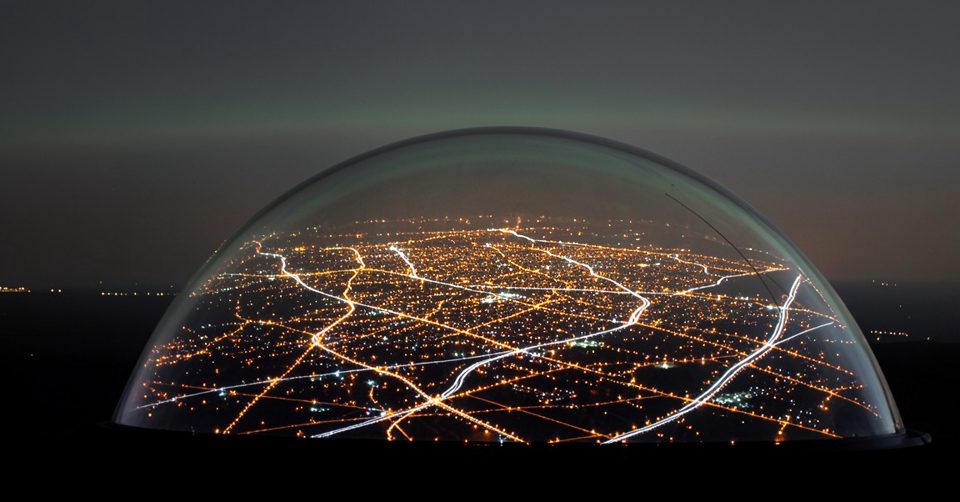
An astronaut aboard the International Space Station photographed the U.S. Midwest on October 18, 2026, capturing a clear view of nighttime lights across the region. The image shows major metropolitan areas like Chicago and Detroit alongside smaller cities and highway networks. The photo also includes a band of airglow along the horizon, providing data useful for tracking urban growth and lighting changes.
New Zealand astrophotographer defends viral satellite image from AI accusations
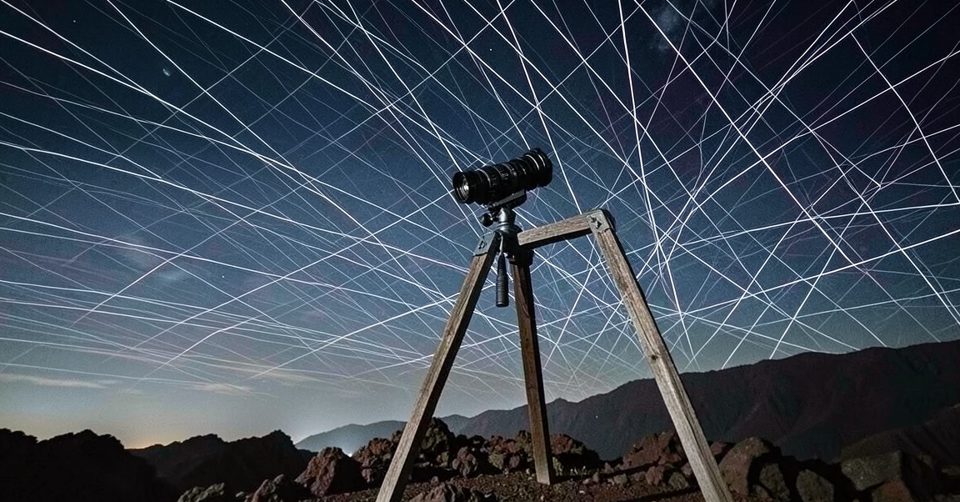
Brendan Larsen is facing accusations that his viral photograph of the night sky over Mount Taranaki was created by artificial intelligence. The image, which shows about 1,400 satellites and 14,000 trails, was created by layering 578 individual photos taken over two hours in September. Larsen spent approximately 40 hours in post-production to erase stars and reveal the dense crisscrossing pattern of satellite trails.
Mediterranean neutrino telescope sets new limits on Einstein's relativity
Researchers from the KM3NeT collaboration analyzed 5,828 atmospheric neutrino events detected by the ORCA telescope in the Mediterranean Sea. The study found no evidence of a violation of Lorentz invariance, a core principle of Einstein's relativity, but established new experimental limits on potential differences in muon and tau neutrino behavior.
The results, published in the Journal of Cosmology and Astroparticle Physics, help investigate whether spacetime is continuous or discrete.

 Illustration