Daily Summary of Science & Space · Live edition, updated continuouslyMonday 23 November 2026 · UTC
Latest Science & Space News Today: 23 November 2026
ALMA weighs early black hole as astronomers find rare triple star system
Astronomers using ALMA measured the mass of a supermassive black hole in a quasar seen when the universe was about 1.3 billion years old. A rare triple star system with two white dwarfs was found 28 light-years away, and researchers modeled a proposed hidden planet beyond Neptune called Planet X2.
Rare triple star system with two white dwarfs found 28 light-years away
Astronomers led by Étienne Artigau of the Trottier Institute at the Université de Montréal found a rare triple star system 28 light-years away while searching for planets. It contains a dim red dwarf and two white dwarfs, one orbiting the red dwarf at 129.3 astronomical units with a roughly 1,000-year orbit. The team says no similar system is known within at least 100 light-years and has no clean explanation for the configuration.
ALMA resolves gravity of a 6.5-billion-solar-mass black hole in early universe
Astronomers using ALMA measured a supermassive black hole's mass in quasar W2246-0526, seen when the universe was about 1.3 billion years old. Tracking gas speeds near the center, they estimated the black hole at about 6.5 billion times the sun's mass and resolved the region where gravity dominates. The team reports it is the first dynamical mass measurement at redshift greater than 2 in an unlensed galaxy with its sphere of influence resolved.
Astronomers model Planet X2, a hidden planet beyond Neptune
Researchers used computer simulations to model a proposed planet beyond Neptune, nicknamed Planet X2, with about 1.5 to 2 times Earth's mass and an orbit hundreds of times farther from the sun than Earth's. The team led by Patryk Sofia Lykawka says its gravity could explain unusual orbits of distant icy objects, and the idea differs from the more massive Planet Nine hypothesis. The Rubin Observatory's survey could help test it.
Gas cloud dims black hole's glow in NGC 3227 for weeks
Astronomers observed a gas cloud dimming a black hole in NGC 3227, about 77 million light-years away, where optical brightness fell by about 70 percent. A broad hydrogen-beta line from fast-moving gas near the black hole dropped by about 80 percent, and both features recovered within about two months. The University of Wyoming team led by Kaiwen Zhang says the decline was unlikely to come from ordinary feeding fluctuations.
Research led by a University of Sydney PhD student found that a massive rotating structure of stars near the galactic center is generating shock waves through surrounding gas clouds. The waves compress the gas, allowing new stars to form where such forces usually suppress star formation. The study, published in Nature Astronomy, also casts doubt on the nature of the Norma spiral arm.
Two quasars from 900 million years after the Big Bang defy explanation
Astronomers identified the most distant compact pair of quasars ever observed, designated J1602+4228AB, about 900 million years after the Big Bang. Each is powered by an enormous black hole that grew unusually large in the Universe's infancy, and scientists have no definitive explanation. The discovery used James Webb Space Telescope and Gemini North observations.
Mercury offers a good chance to be spotted in the morning sky
Mercury reached greatest western elongation on 20 November, making it a good opportunity to see the smallest planet in the solar system. It remains well placed in the morning sky for the next few mornings, appearing low on the horizon below and to the left of Venus. Observers need an unobstructed view between 0600 and 0615 GMT, and southern hemisphere viewers will find it lower and harder to spot.
Mysterious new viruses reveal missing link in evolution
University of Miami researchers discovered a previously unknown group of viruses that may explain a missing piece of evolutionary history. The viruses have smaller, simpler genomes than other viruses that produce HK97 fold protein shells and show characteristics of both viruses and encapsulins. Published in Nature Communications, the finding suggests viruses and encapsulins may have repeatedly evolved from one another over millions of years.
NASA's Astronomy Picture of the Day features Lynds 1251
NASA's Astronomy Picture of the Day for November 23, 2026, shows Lynds 1251, also called the Rotten Fish Nebula, a star forming region filled with opaque interstellar dust. The processed image shows dark dust along with young stars, energetic shock waves, fast stellar winds and powerfully beamed jets.
NASA's next generation laser system debuts in Svalbard
NASA's next generation satellite laser ranging system has begun operating at the Ny-Ålesund Geodetic Observatory in Svalbard, Norway, making it the northernmost laser tracking facility on Earth. The system can fire laser pulses thousands of times per second and detect single photons, improving the precision used to track satellites and help define Earth's coordinate frame.
X-rays reveal 100 million year old flower hidden in museum rock
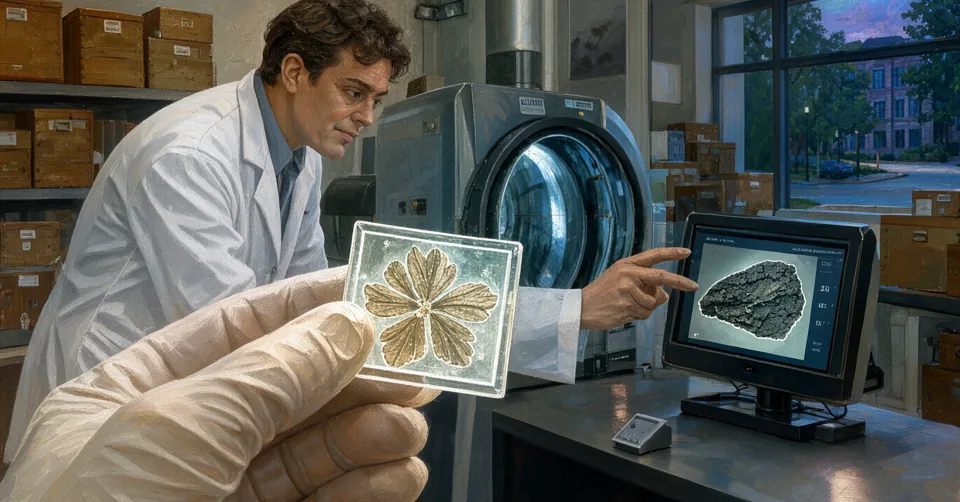
Scientists from the U.S. and UK reported a fossil flower from the mid-Cretaceous, about 100 million years ago, hidden in a museum rock collected more than 130 years ago. Named Tomlinsoniella pedicellata, it is no larger than a grain of rice and was found by X-ray scanning while examining another fossil. The team says it is an early record of a palm-like monocot and opens a new window into the evolution of modern plants.
Deepest explosive undersea eruption found in Mariana Trench
A remotely operated vehicle sampling the walls of the Mariana Trench's Challenger Deep found pyroclastic rocks from explosive underwater eruptions, the deepest such flows documented in the ocean. The rocks lie in the forearc near the trench, where the mantle is generally not hot enough to melt, so the finding surprised scientists. The study, reported in Frontiers in Earth Science, may help explain why the trench is so deep.

 Illustration