Daily Summary of Climate & Energy · Final editionSaturday 28 November 2026 · UTC
Climate & Energy News: 28 November 2026
Harbinger raises $340M as Germany solar tops 100 TWh and Guatemalans face US deportations
Electric truck maker Harbinger raised $340 million after a FedEx order and a US military contract, funding expansion into energy storage, power generation, autonomy software, defense and manufacturing. Germany generated more than 100 TWh of solar power for the first time, making solar its second-largest net electricity source behind wind.
In Guatemala, drought and rising US deportations are leaving rural families with fewer options as migration serves as an economic lifeline.
Harbinger raises $340M after FedEx order and US military contract
Electric truck maker Harbinger secured $240 million in a Series D round co-led by Tiger Global, Capricorn Technology Impact Fund and Ridgeline, plus $100 million in senior debt and a convertible note. The financing follows a $300 million FedEx order for 2,000 medium-duty electric trucks and a US military contract. The company says the money will support expansion into energy storage, power generation, autonomy software, defense and manufacturing.
Kaua'i honeycreepers face extinction as mosquitoes spread avian malaria
Researchers estimate that all of Kaua'i's endemic honeycreeper species could be lost as soon as Christmas after an unprecedented swarm of southern house mosquitoes reached higher-elevation forests. The mosquitoes spread avian malaria, which can kill honeycreepers after one or two bites. Last year Kaua'i lost its last wild 'akikiki, and estimates put the 'amakihi population at under 500 this year, down from about 9,000 in 2023.
New model optimizes perovskite-silicon tandem solar cells for satellites
A team led by South Korea's Yonsei University developed a simulation framework to optimize perovskite-silicon tandem solar cells for satellite power systems. The model accounts for sunlight angle and cell temperature to find the perovskite absorber thickness that maximizes average short-circuit current density in a given orbit. The team modeled four perovskite compositions and applied it to three satellites in low Earth and medium Earth orbit.
Peru reports 1.24 GW of installed solar capacity across 22 plants
Peru has 22 solar power plants in operation with a combined installed capacity of 1,241 MW, according to the Ministry of Energy and Mines. Seventeen are connected to the national grid and five operate in isolated systems, with Arequipa, Moquegua and Ica holding 97.3% of capacity. Solar supplied 4.3% of Peru's total electricity generation in the first eight months of 2026.
Cellular base stations may affect solar module performance
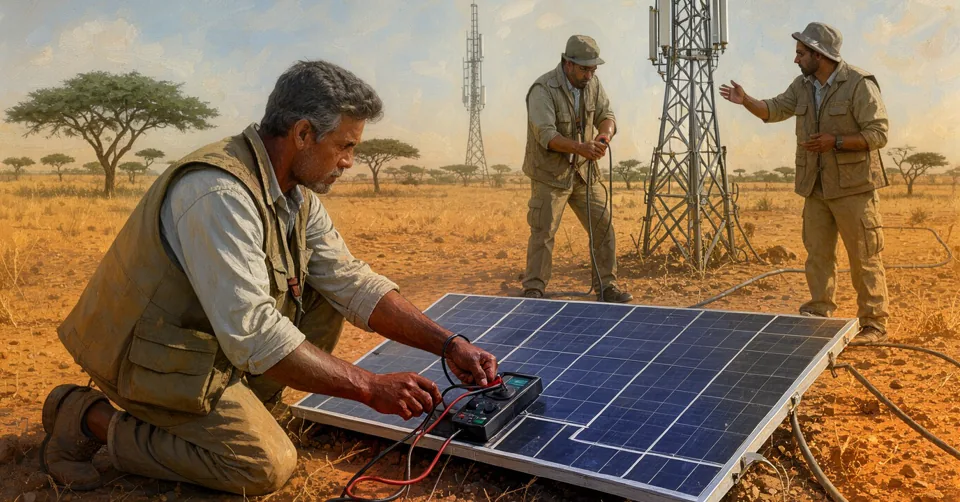
Researchers at Joseph Ki-Zerbo University in Burkina Faso tested a 50 W monocrystalline silicon solar module at five distances from a cellular base station. They found the electric field peaked at 15.76 V/m at 27.64 m, where the module's series and shunt resistances were lowest. The module produced its highest measured output, 30.1 W, at 14.24 m, compared with 28.0 W at the point of maximum electromagnetic exposure.
Germany's solar generation tops 100 TWh for first time
Fraunhofer ISE data show Germany generated 100.2 TWh of solar power by the morning of Nov. 27, 2026, the first annual total above 100 TWh. Solar was the country's second-largest net electricity source behind wind, with 124.4 TWh from onshore and offshore wind. Output rose 10 TWh from 90 TWh in 2025, while combined coal generation stayed below solar.
UK brussels sprouts are smaller after hot, dry summer
Brussels sprouts for the UK festive season are likely to be smaller than usual after heatwaves and drought across Wales and most of England hit the water-loving crop. Low water reserves limited irrigation, slowing growth of sprouts and other brassicas such as cabbages, broccoli and cauliflowers. Oddbox says it is receiving unusually high volumes of stunted sprouts, mostly from Lincolnshire.
Australia is on track for its net-zero by 2050 commitment, but execution remains the harder step after pledges. Capital investment, energy efficiency and emissions data are needed to manage costs, supply risk and regulatory pressure. Fragmented data across energy, operations, maintenance, finance and sustainability teams is a major barrier.

 Illustration