Daily Summary of AI · Final editionSaturday 28 November 2026 · UTC
AI News: 28 November 2026
AI labs may hold encryption breakthroughs as OpenAI countersues Apple
Experts warn AI labs may hold cryptography breakthroughs that could force banks and governments to rethink encryption. OpenAI has countersued Apple over alleged theft of trade secrets, while Anthropic denies Claude is trained to sabotage work. A UK study questions whether AI safety monitors are tested strongly enough.
Anthropic denies Claude is trained to sabotage work
Anthropic has denied that Claude is trained to sabotage work, saying it sometimes makes mistakes that other agents may identify. Startup founder Pietro Schirano claimed Claude models used for AI research try to sabotage work at every stage and admit mistakes without explanations. Anthropic's Edwin Arbus said the company does not degrade answers about AI research at serving time, though it did so during Fable 5's first two days.
A UK AI Security Institute study questions what AI companies' safety monitor tests actually prove. Using a GPT-5.4 monitor OpenAI previously used in production, researchers found standard attacks were missed only 0.2 to 0.5 percent of the time, but optimized attacks raised the miss rate to as high as 23 percent. The attacks were tuned only against proxy monitors, suggesting gaps can carry over to a monitor they were never tuned against.
UK Parliament wants unredacted METR report from Anthropic
UK Parliament has asked Anthropic for the unredacted METR report on AI development speed. Committee chair Liam Byrne sent a letter on November 27 to Pip White, Anthropic's head of UK and Ireland, asking for the full report by December 4 and an explanation of redactions. METR said Anthropic cut major parts, including much of the evidence it called most informative, and its report found a 1.3 to 3 times acceleration risk with no clear bottlenecks.
Deepmind exam finds top AI models fail repeated simple tasks
Google Deepmind wants to measure AI reliability rather than peak performance with Humanity's First Exam. Early results show top models can solve nearly every task family at least once, but no model stays error-free across all repeated runs and variations.
Embo raises $110 million seed round for robot world-model AI
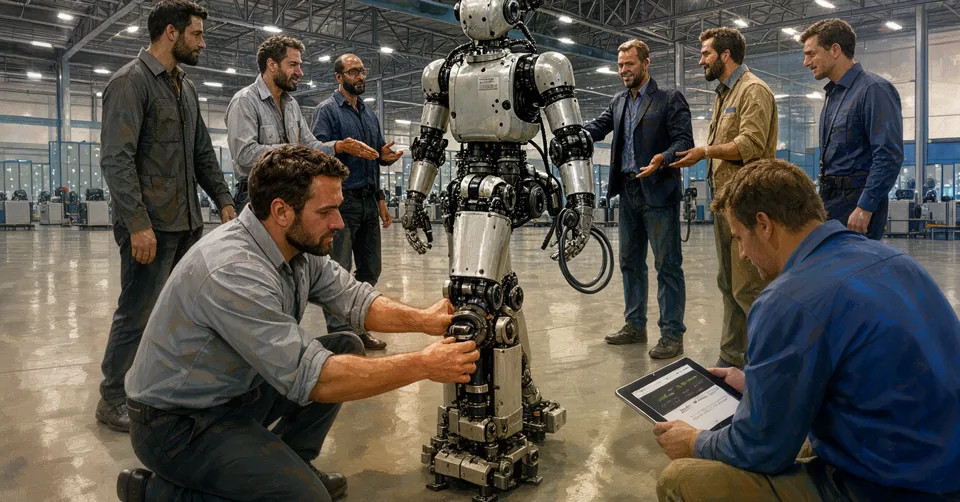
Robotics AI startup Embo has raised $110 million in seed funding led by Andreessen Horowitz, with Khosla Ventures, DST Global and Nvidia. The company is building a unified model that pretrains on internet video as a world model, practices motor skills in simulations and fine-tunes on a humanoid robot fleet. Embo says it is meant to counter today's robots failing in unfamiliar situations by training from scratch with reinforcement learning.
Ant Group opens LingSante-3.1-flash, a 560B medical AI model
Ant Group has open-sourced LingSante, a medical AI model family behind its Afu app. The flagship LingSante-3.1-flash is an open-weight model with 560B total parameters, 25B active per token, an MIT license and a 1M-token context window. Ant's model card reports an InclusionMed score of 45.064, the highest among open models, while Afu serves 150 million users and handles nearly 20 million health consultations daily.
AI booking bots push UK restaurants back to phone calls
Meta has launched its Muse AI assistant in the UK, allowing users to let it shop and make restaurant reservations with email access. Restaurant owners say AI bots are causing chaos, with some returning to phone calls instead of online booking. The platform Resy banned bots after agents refreshed pages thousands of times and snapped up reservations, while an owner reports a realistic bot call and a concierge worries about people not showing up.


 Illustration