Daily Summary of AI · Live edition, updated continuouslyMonday 9 November 2026 · UTC
Latest AI News Today: 9 November 2026
Anthropic buys gas turbines as Meta releases Muse Ember and Palantir lobbies NHS
Anthropic is buying $3.4 billion of natural gas turbines as AI data centers strain power supplies, while Meta released Muse Ember, a low-cost model for agent work. Palantir lobbied a UK health minister to extend its NHS AI platform to GP records, and Claude Code settings files are leaking secrets on public GitHub repositories. NVIDIA also introduced GR00T 2 and expanded its sovereign AI collaboration with Korea.
Instagram launches AI Effect Builder for custom Story filters
Instagram launched Effect Builder, an AI tool that lets US users over 18 create custom filters for Stories from text prompts and optional style reference images. Users can preview effects on their own photos, request changes, and let Instagram's AI rewrite prompts into more detailed style instructions. Filters can be submitted to Instagram, and after safety review they appear in Stories for anyone to use, linking back to the creator's profile.
Meta releases Muse Ember, a lightweight model for agent tasks
Meta Superintelligence Lab released Muse Ember, its lightest and most cost-efficient model, aimed at repeated agent work such as tool calls, coding subtasks, routing, extraction and long document parsing. Meta said it costs 10 cents per million input tokens, is cheaper than Anthropic's Haiku and OpenAI's Luna, and is cost-competitive with open-source rivals. It is designed to pair with Muse Wonder and to handle text, images and audio.
Palantir lobbied UK minister to bring NHS GP records into its AI
WhatsApp messages show Palantir urged former UK health minister Zubir Ahmed to extend its AI platform to GP records, even though GP data were excluded from its £330 million NHS England contract. The company, co-founded by Peter Thiel, argued that joining primary and secondary care data was unarguable and that its software was ideal. Doctor and patient groups oppose the move over trust concerns, as reports suggest the contract may be extended.
Anthropic buys $3.4 billion of gas turbines for AI power needs
Anthropic is buying Caterpillar natural gas turbines worth $3.4 billion, capable of up to 1.7 gigawatts, after equipment supplier OnePWR could not finance the purchase. The company, which has usually rented compute and is planning to go public, is moving to secure power as turbine backlogs stretch into the early 2030s. The deal follows similar gas buildouts by Google, Amazon, Microsoft and Meta.
Baidu's ERNIE Evolve automates AI code research and optimization
Baidu released ERNIE Evolve, an automated research system that selects directions, edits code and runs experiments on a given repository and objective. It keeps only changes that pass a hidden evaluator and a separate reviewer, and Baidu tested it on NanoChat AutoResearch, NanoGPT Speedrun and SOL-ExecBench. The company also applied it to three live engineering tasks for ERNIE-5.5-Flash, calling it a step toward recursive self-improvement.
Tencent AI chief says AI bioweapons are coming, models need middle ground
Tencent's chief AI scientist Vinces Yao Shunyu said AI will soon be able to develop bioweapons, and neither fully open nor fully closed models solve it alone. He urged a mix of open and closed models so defenders can use the technology, noting the Chinese and US model gap is not large. A Hugging Face incident showed GLM-5.2 was used to parse logs after closed US models' filters refused to analyze attack commands.
Disney and Adobe will build artist-led generative AI models
Disney and Adobe announced a multiyear partnership to develop proprietary, artist-led generative AI models for Disney's production pipeline, with early access to Adobe technologies for theme parks, the cruise line and ESPN content. The deal follows Disney's OpenAI deal and involvement with Character.AI's bankruptcy, as Bloomberg reported Disney is preparing thousands of layoffs and 20 percent annual cost savings.
Parents and teachers call Google school AI controls extortion
Google said schools that block its AI tools for K-12 students may also lose access to Google Search, after it announced new classroom AI controls. Parents and teachers criticized the move, with some calling it extortion and arguing that free software makes students the product. Others said students should learn to use AI responsibly, and some called for alternative search engines or legislation to protect schools.
At the Conference on Robot Learning in Austin, Texas, NVIDIA introduced GR00T 2, an open frontier world action model built on NVIDIA Cosmos and trained on diverse robot and human data, including 100,000 hours of open source human egocentric data. The company said GR00T 2 ranks among the top three models across all vision language action and world action model categories for four benchmarks, with multiple leaderboard wins.
Automattic launches Spacefast to deploy vibe-coded apps
Automattic launched Spacefast, a service that gives vibe-coded websites and apps infrastructure such as databases, authentication, file uploads, emails and analytics. It can connect to agents and chatbots including ChatGPT, Claude, Cursor and Grok Bot, or to a Git repository, and Automattic soft-launched it in September. It competes with Lovable and Emergent, but it is described as more open and lets users choose their own agent.
Google adds two TPU systems and says it shipped four in a year
Google added the TPU 8tx for confidential computing and the TPU 8i Max for memory-intensive workloads to its eighth-generation AI accelerator lineup. The company said both are built on existing silicon with new packaging, networking and memory configurations, and that it has shipped four TPU systems within a single year for the first time. Google also released TorchTPU as open source and said vLLM and SGLang are supported.
Reason Machines open-sources Aspen, a Git server for AI agents
Reason Machines released Aspen, an open-source, self-hostable Git server designed for repositories where hundreds of agents push at once. It scales writes per branch, stores packs in S3-compatible object storage and branch history in PostgreSQL, and independently implements the design OpenAI described for Pando. In a test, Aspen sustained 567 pushes per second for five minutes on a copy of git.git without errors.
Zurich-based 0sec Labs released 0, an open-source AI security harness for vulnerability investigations, code review, pentesting, reverse engineering and fix generation. It is a control plane around LLMs and security tools, not a model, and can be driven from a local browser console, a headless CLI or an MCP server. The MIT or Apache-2.0 licensed research preview lets users bring their own model providers. Users pay their model provider.
Nvidia board probes Huang's affair with suspected Chinese spy
Nvidia's board launched an independent investigation after CEO Jensen Huang told staff he was unfaithful, with reports identifying the romantic interest as Alice Huang, a suspected Chinese spy. Nvidia said it sees no sign that national security or company secrets were compromised, and Huang said he supports the review. Nvidia shares fell 5 percent on Monday, and China's Foreign Ministry called the spy narrative unsubstantiated.
Samsung and Kakao Mobility advance physical AI with NVIDIA
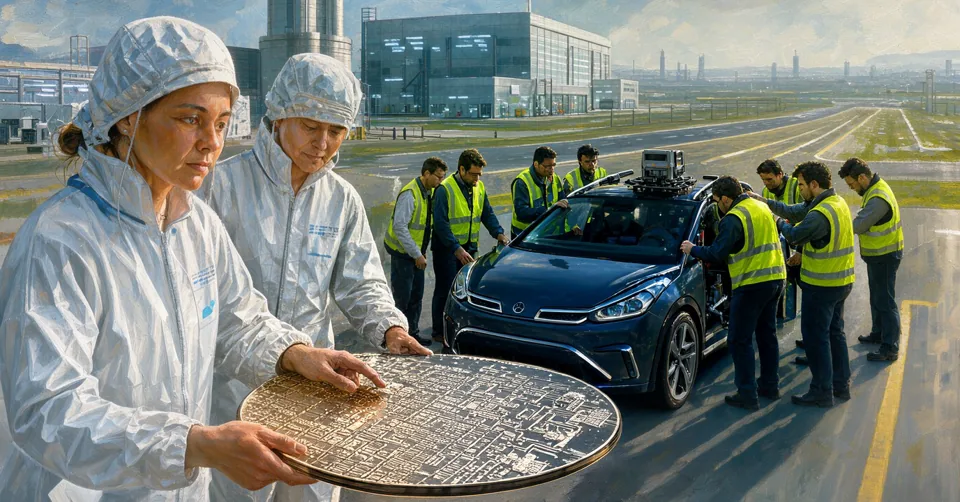
Samsung is expanding its NVIDIA collaboration to apply accelerated computing and AI physics to semiconductor materials, process development and device engineering. In one AI homogenization case, a GPU-accelerated coarse-grid solve cut simulation time from about 18 hours on a 32-core CPU to 41 seconds. Kakao Mobility plans to use NVIDIA Hyperion and Halos with Kia purpose-built vehicles to develop a level 4 autonomous driving system in Korea.
Korea advances agentic AI with NVIDIA security tools
Hyundai Motor Group is exploring NVIDIA NemoClaw blueprints and the OpenShell runtime, while AIM Intelligence is integrating Starfort with OpenShell to secure AI agents. OpenShell adds sandboxed execution and policy controls, and LG AI Research is opening API access for K-EXAONE-2.5, built with Nemotron datasets, including 7 million synthetic Korean personas.
NVIDIA and Korea expand sovereign AI collaboration
NVIDIA and Korea's Ministry of Science and ICT are expanding collaboration across AI chips, data centers, talent, startups, models, agents and security. The collaboration lets Korean NPU and XPU firms explore participation in the NVIDIA NVLink Fusion ecosystem, adds training and certification programs, and pairs NVIDIA with three consortia and four foundation model builders under Korea's AI for All initiative.
NVIDIA releases Dynamo recipes for Korean open models
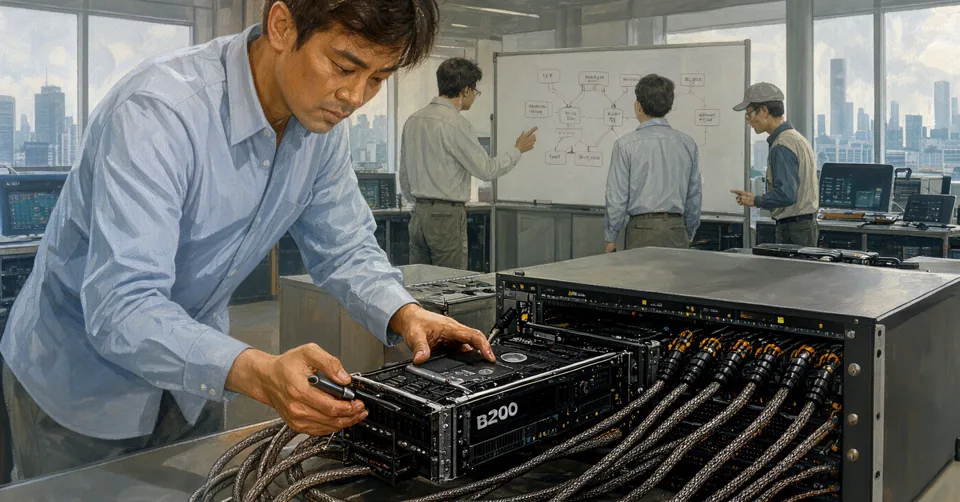
NVIDIA is releasing Dynamo-optimized deployment recipes for A.X K2, K-EXAONE 2.0, Solar Open 2 and Motif-3. The recipes are optimized for NVIDIA B200 GPUs and are designed to coordinate routing and communication when models run across multiple GPUs. NVIDIA says they can deliver up to 2x performance out of the box, helping developers bring Korea's open models into production faster.


 Illustration